
Blackjack rules fit on one card. You play against the dealer only. Both of you start with two cards, and the aim is to finish nearer to 21 than the dealer without passing it. Go over and you lose at once, even if the dealer goes over later. That last detail is where the casino's edge comes from, and everything else in the game is about managing it.
On this page
Card values and what you are aiming for
| Card | Value |
|---|---|
| 2 to 9 | face value |
| 10, jack, queen, king | 10 |
| Ace | 1 or 11, whichever helps |
Suits play no part in the main game. A hand with an ace counted as 11 is soft: ace and 6 is soft 17, and it cannot bust on the next card, because the ace can drop to 1. A hand without that cushion is hard.
An ace plus any ten-value card as your first two cards is a natural, or blackjack. It beats every other 21 at the table, including a 21 the dealer makes with three cards.
How a round runs
- Bet. You place your stake before any card is dealt.
- Deal. You get two cards face up. The dealer gets one face up (the upcard) and, at most tables, one face down (the hole card).
- Insurance, if the dealer shows an ace. You may put up to half your stake on the dealer having blackjack; it pays 2:1. Our insurance and side bets page shows why it is a poor buy.
- Peek. With an ace or a ten showing, the dealer checks the hole card. A dealer blackjack ends the round: you lose unless you also hold a natural, which pushes.
- Your decisions. You act on your hand until you stand or bust.
- Dealer's turn. The dealer reveals the hole card and draws by the house rule.
- Settle. Higher total wins; equal totals push and the stake comes back.
The five moves you can make
| Move | What happens | When you may use it |
|---|---|---|
| Hit | Take another card | Any time before you stand, as long as you are under 21 |
| Stand | Keep your total and end your turn | Any time |
| Double | Add a second stake equal to the first and take exactly one card | First two cards; some tables only on 9, 10 or 11 |
| Split | Separate a pair into two hands, each with its own stake | First two cards of equal value; re-splitting usually up to four hands, split aces get one card each |
| Surrender | Give up the hand and get half the stake back | First two cards only, and only where the table offers it |
Which move is right in each spot is a separate subject, answered in full by our basic strategy chart. The blackjack rules only tell you what is allowed.
What the dealer must do
The dealer has no choices. The house rule is printed on the table or in the game's info screen:
- 16 or less: the dealer draws.
- 17 or more: the dealer stops.
- Soft 17: at most tables the dealer stands (S17). At some, the dealer hits (H17). That one word costs players about 0.22% of every stake, in Wizard of Odds' calculation.
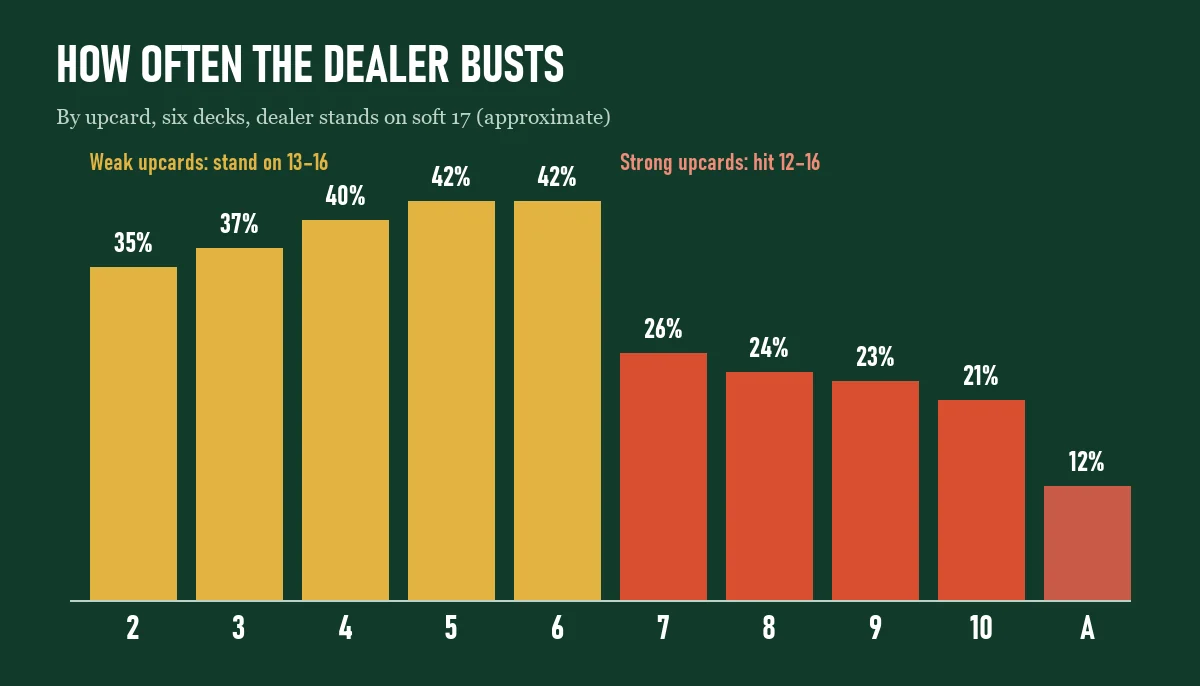
If the dealer busts, every hand still in play wins. If not, totals are compared. Because the dealer always plays after you, a hand you bust is lost before the dealer turns a card, which is why the game is not an even contest despite the identical target.
Payouts: 3:2 and its cheaper cousins
| Result | Pays | Profit on a $20 stake |
|---|---|---|
| Ordinary win | 1:1 | $20 |
| Natural at a 3:2 table | 3:2 | $30 |
| Natural at a 6:5 table | 6:5 | $24 |
| Push | stake returned | $0 |
| Surrender | half the stake returned | −$10 |
| Insurance when the dealer has blackjack | 2:1 on the insurance stake | $20 on a $10 insurance bet |
How often does the payout on a natural matter? From an eight-deck shoe the chance of an ace and a ten-value card is 2 × 32/416 × 128/415 ≈ 4.75%, about once every 21 hands. Six decks give the same 4.75% to two decimals; a single deck, 4.83%. Shaving the payout on those hands is expensive. Measured against a standard eight-deck game, Wizard of Odds puts the cost at:
- 7:5 on a natural: 0.45% of every stake
- 6:5 on a natural: 1.39%
- 1:1 on a natural: 2.27%
Our 3:2 vs 6:5 page turns the 6:5 figure into session money, and the house edge page prices the other table rules.
A hand walked through
You stake $20 at an eight-deck table where the dealer stands on soft 17 and naturals pay 3:2.
- Deal. You get 6 and 5: hard 11. The dealer shows a 6.
- Peek. No peek is needed: a 6 cannot make a dealer blackjack.
- Your move. Eleven against a 6 is a textbook double. You add $20, so $40 rides, and take one card: a 9. You stand on 20 automatically.
- Dealer's turn. The hole card is a king: 16. The dealer must draw and gets an 8. That makes 24, a bust.
- Settle. Your $40 wins even money: $40 profit.
Change one thing. Same stake, and this time you are dealt ace and queen while the dealer shows a 9. You have a natural; the dealer cannot have one with a 9 up, so you are paid at once: $30 at 3:2, or $24 if the table paid 6:5. Same cards, $6 apart.
Play live and RNG blackjack with crypto.
How often each result comes up
Over a long run of basic-strategy play, Wizard of Odds' simulation puts the split of hands at:
| Result | Share of hands |
|---|---|
| Win | 42.43% |
| Push | 8.48% |
| Loss | 49.09% |
You lose more hands than you win, yet a good table keeps only a fraction of a percent of stakes. The gap is closed by the hands that pay more than one stake: naturals at 3:2, and doubles and splits where you have more money out when the odds favour you.
Blackjack rules to read before you sit down
Every table publishes its own version of the blackjack rules. Check these lines in the info screen, in this order:
- Natural payout: 3:2, or something less.
- Soft 17: dealer stands or hits.
- Decks: usually six or eight online; the game can be dealt with anything from one to eight.
- Doubling: any two cards, or only certain totals; allowed after a split or not.
- Splitting: how many hands, and what happens with aces.
- Surrender: offered or not.
- Hole card: whether the dealer peeks, or takes a second card only after players act.
Live tables and RNG tables use the same blackjack rules; the live blackjack guide covers what changes on camera. Once these lines make sense, the next step is learning when each move pays, and whether tracking the cards gets you anywhere online: our card counting page answers that one with numbers. Tables that pay 3:2 are easy to find at the crypto casinos we compare.
Questions and answers
What are the basic blackjack rules?
You and the dealer each get two cards. You draw more or stop, trying to finish closer to 21 than the dealer without going over; the dealer then draws by a fixed rule. A higher total wins even money.
Is an ace 1 or 11?
Either. It counts as 11 unless that would take your total over 21, in which case it counts as 1. A hand where the ace still counts as 11 is called soft.
Does a natural blackjack beat any 21?
Yes. An ace with a ten-value card as your first two cards outranks a 21 made with three or more cards, and pays more than a normal win.
Can the dealer choose to hit or stand?
No. The dealer draws on 16 or less and stops on 17 or more, with one table-specific detail: whether the dealer also draws on a soft 17.
Are blackjack rules different online?
The game is the same. What varies from table to table is a handful of options, such as 3:2 or 6:5, soft 17, surrender and how many times you may split, and each table lists them in its info screen.