
The house edge in blackjack is the share of everything you stake that the casino keeps over time. Unlike a slot, where the studio fixes one number, blackjack's edge is built from the table's rules, and each rule has a known price. Learn the prices and you can work out any table's edge in your head.
On this page
The starting point
Take the rule set most online tables use:
- six to eight decks
- dealer stands on soft 17
- double on any two cards
- double after split allowed
- split up to four hands, aces split once
- no surrender
- blackjack pays 3:2
- dealer checks for blackjack
With basic strategy, this game keeps about 0.45%. That is a 99.55% return to player.
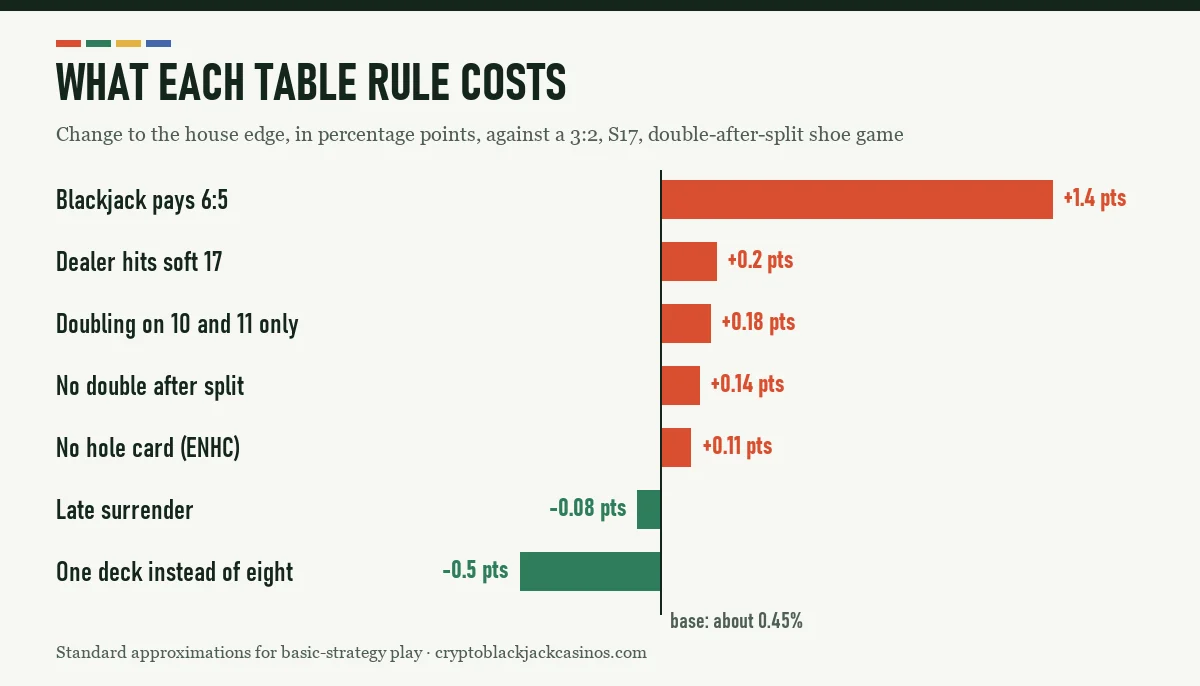
What each rule changes
| Rule | Change to the edge | Direction |
|---|---|---|
| Blackjack pays 6:5 | about +1.4 points | worse |
| Blackjack pays 1:1 (rare) | about +2.3 points | far worse |
| Dealer hits soft 17 | about +0.2 points | worse |
| No double after split | about +0.14 points | worse |
| Double on 10 and 11 only | about +0.18 points | worse |
| Double on 9 to 11 only | about +0.09 points | worse |
| No hole card, extra bets lost to a dealer blackjack | about +0.11 points | worse |
| Late surrender | about −0.08 points | better |
| Re-split aces allowed | about −0.08 points | better |
| One deck instead of eight | about −0.5 points | better |
| Six decks instead of eight | about −0.02 points | slightly better |
These are standard approximations for basic-strategy play. Exact values move by a few hundredths with the deck count, which never changes the order.
Worked examples
A typical live studio table. Eight decks, S17, double after split, 3:2. Nothing to add to the base: about 0.45%.
The same table with surrender. 0.45 − 0.08 ≈ 0.37%.
An H17 table. 0.45 + 0.2 ≈ 0.65%.
A 6:5 table that hits soft 17. 0.45 + 1.4 + 0.2 ≈ 2.05%.
A no-hole-card table without double after split. 0.45 + 0.11 + 0.14 ≈ 0.7%.
Why 6:5 is so expensive
A natural blackjack comes in about 4.75% of hands. At 3:2 it pays 1.5 bets; at 6:5 it pays 1.2. The 0.3-bet difference, on 4.75% of hands, is 0.3 × 4.75% ≈ 1.4% of every stake. Nothing else on the table comes close. Our 3:2 vs 6:5 page works through it with session numbers.
Play live and RNG blackjack with crypto.
From edge to money
The expected cost of a session is: hands × stake × edge.
| Hands | Stake | 0.37% | 0.45% | 0.65% | 2.05% |
|---|---|---|---|---|---|
| 100 | $10 | $3.70 | $4.50 | $6.50 | $20.50 |
| 500 | $10 | $18.50 | $22.50 | $32.50 | $102.50 |
| 500 | $50 | $92.50 | $112.50 | $162.50 | $512.50 |
Single sessions swing well above and below these numbers. Over many sessions, results drift toward them.
What the edge does not include
- Side bets. Each has its own, usually much higher edge. See insurance and side bets.
- Your mistakes. The figures assume basic strategy. Our chart covers every hand.
- Bonus terms. Blackjack often counts little or nothing toward wagering, so a bonus rarely changes the picture.
Finding the rules at a crypto casino
Open the table, then its info or help screen. Look for the lines on blackjack payout, soft 17, doubling, splitting, surrender and decks. If a table does not state one of them, assume the less favourable version until you confirm otherwise. The casinos we compare are listed on the home page.
Questions and answers
What is the house edge in blackjack?
The share of total stakes the casino keeps in the long run. On a common online table (six to eight decks, dealer stands on soft 17, double after split, 3:2) it is about 0.45% with basic strategy.
Which blackjack rule hurts the player most?
A 6:5 payout on blackjack. It adds about 1.4 percentage points to the house edge.
Does the number of decks matter?
A little. With the same rules, a single-deck game has an edge about half a point lower than an eight-deck game. Six and eight decks differ by only a few hundredths of a point.
Is the house edge the same as the RTP?
They are two sides of one number. A 0.45% house edge means a 99.55% return to player with basic strategy.