
Single deck blackjack is the version card players ask for by name, and for a good reason: with every other rule held equal, one deck gives the player a smaller house edge than any shoe. The catch is that tables rarely hold every other rule equal. A one-deck game that pays 3:2 is the cheapest blackjack you can find. A one-deck game that pays 6:5 costs about three times what a normal six-deck table does. The payout line decides which of the two you are looking at.
On this page
Verdict in three lines
- Same rules, one deck wins: about 0.48 points lower than eight decks and about 0.46 lower than six.
- 6:5 on one deck loses: the short payout costs about 1.39 points, far more than the deck gives back.
- Pick by payout first, decks second. A 3:2 shoe beats a 6:5 single deck every time.
Single deck vs six and eight decks, side by side
| Single deck | Six or eight decks | |
|---|---|---|
| Deck effect vs eight decks | −0.48 points | −0.02 (six) / 0 (eight) |
| Natural blackjack per hand | about 4.83% | about 4.75% |
| Usual blackjack payout | 3:2 or 6:5, check every table | usually 3:2 |
| Card removal | strong: each card dealt shifts the odds | weak: one card barely moves a big shoe |
| Shuffle | RNG tables often reshuffle each hand | shoe cut and reshuffled; RNG often each hand |
| Doubling and splitting rules | sometimes restricted to offset the deck | double after split common |
| Edge with 3:2, dealer stands on soft 17, double after split | about −0.03% | about 0.43% (six) / 0.45% (eight) |
| Edge with 6:5, same other rules | about 1.36% | about 1.82% (six) |
The deck effects come from the Wizard of Odds table of rule variations. The edges are our own sums from those effects, starting at about 0.45% for an eight-deck game with standard rules, the same base our house edge page uses.
Why one deck helps the player
Two effects, both from arithmetic.
More naturals. The chance of a two-card blackjack is 2 × (aces ÷ cards) × (tens ÷ cards left):
- one deck: 2 × 4/52 × 16/51 ≈ 4.83%
- eight decks: 2 × 32/416 × 128/415 ≈ 4.75%
At 3:2 each natural pays half a bet extra, so a few extra naturals per thousand hands are worth something.
Card removal helps your doubles. Say you hold 6-5 and the dealer shows a 6. On one deck, three non-tens are gone and 16 of the 49 remaining cards are tens: 32.7%. In an eight-deck shoe it is 128 of 413: 31.0%. Your double on 11 catches a ten more often from one deck. The same removal works on many decisions, and together they add up to the half-point gap.
Why single-deck tables pay 6:5
Because the half point the deck gives you is less than the payout takes. The 6:5 rule pays 0.3 bets less on every natural; at about 4.8% naturals per hand that is roughly 1.4% of all stakes, and Wizard of Odds puts the effect at 1.39 points. Subtract the 0.48 the deck gives you and the casino is about 0.9 points ahead of where it would be on an ordinary 3:2 shoe. A single-deck sign does the selling; the payout line does the earning. Our 3:2 vs 6:5 page prices the short payout over a whole session.
Other trims to watch on single-deck tables:
- Dealer hits soft 17: about +0.22 points.
- No double after split: about +0.11.
- Double on 10 and 11 only: about +0.14.
When to choose one deck, when a shoe
Choose single deck blackjack when the info screen says blackjack pays 3:2 and the other rules are close to standard. Even with the dealer hitting soft 17 and no double after split, a 3:2 single deck lands around 0.30%, still under a standard six-deck table at 0.43%.
Choose a six- or eight-deck shoe when the only single-deck table pays 6:5, or when it restricts doubling to 10 and 11 and also hits soft 17. A shoe at 3:2 is the steadier bet on rules, and most live studio tables run a shoe; our live blackjack guide covers those formats.
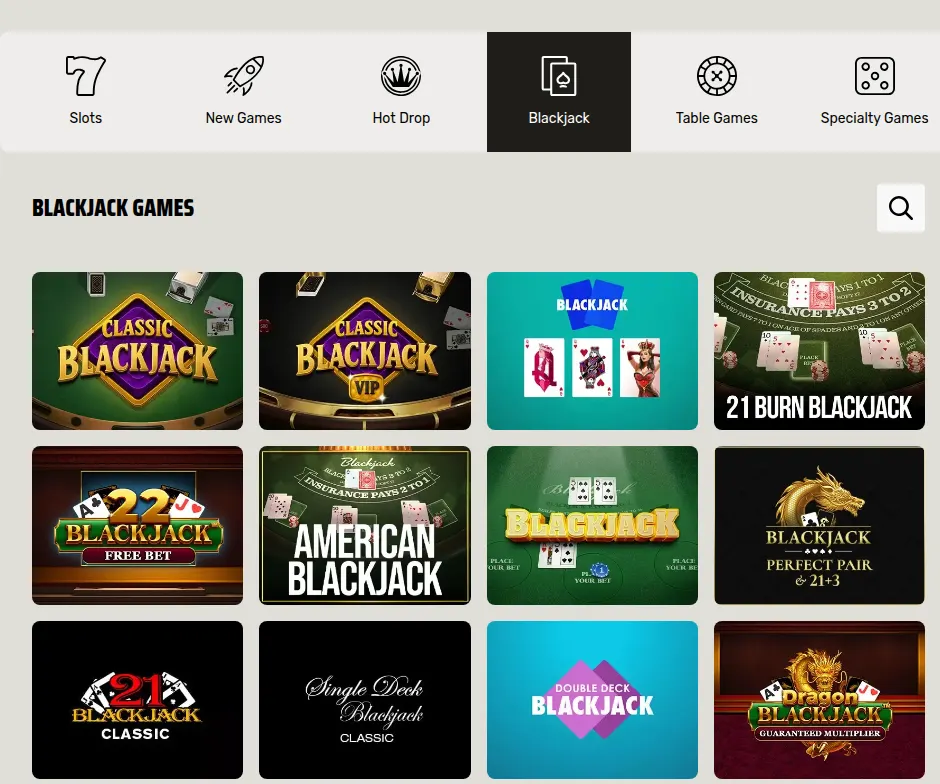
Ignition's RNG blackjack list runs from single deck to European, so you can compare rule sets in one lobby; open each game's rules before you choose.
Example: 500 hands at $10
Expected cost = hands × stake × house edge. 500 hands at $10 is $5,000 staked.
| Table | House edge | Expected cost |
|---|---|---|
| Single deck, 3:2, dealer stands on soft 17, double after split | about −0.03% | about $1.50 in your favour |
| Single deck, 3:2, dealer hits soft 17, no double after split | about 0.30% | about $15 |
| Six decks, 3:2, dealer stands on soft 17, double after split | about 0.43% | about $21.50 |
| Six decks, 3:2, dealer hits soft 17 | about 0.65% | about $32.50 |
| Single deck, 6:5, dealer stands on soft 17, double after split | about 1.36% | about $68 |
| Single deck, 6:5, dealer hits soft 17, no double after split | about 1.69% | about $84.50 |
The worst single-deck table costs about four times as much as the ordinary shoe. The best one costs almost nothing, assuming basic strategy on every hand; these are long-run averages, and one session can swing far either way.
Play live and RNG blackjack with crypto.
Mistakes with single-deck tables
- Reading "single deck" as "low edge". Check the payout first. If it says 6:5, the deck count is the smaller number.
- Using a shoe chart without checking. A few single-deck decisions differ, mostly doubles. Our basic strategy chart is a good start; play it accurately and the gap is small.
- Counting cards against a reshuffle. Many RNG tables shuffle before every hand, so each deal starts from 52 cards.
- Adding side bets. A side bet's edge is usually several percent and wipes out the deck advantage; see insurance and side bets.
Where to find single deck blackjack with crypto
The casinos below are ordered by our score. Not every lobby lists a one-deck game, and payouts differ by title, so open the rules of each single deck blackjack game before you sit down.
- 1
Vave
4.9/5Casino and sportsbook on one balance, with around 90 coins in the cashier.
Latcas B.V. · since 2022 · Licence Curaçao OGL/2024/1676/0905 · 90 coins: BTC, ETH, USDT, LTC · Sportsbook on the same account
- 2
Bitcasino.io
4.8/5The highest written weekly withdrawal cap we found: 1,000,000 USDT.
EZ Spins Ltd · Licence Anjouan ALSI-202509076 · Withdrawal cap 1,000,000 USDT per week (clause 6.10) · ID check above €2,500 · Sportsbook on the same account
- 3
Cafe Casino
4.4/5Twenty-plus blackjack games, Pontoon and Pirate 21 among them, with a crypto cashier.
Arbol Media B.V. · Licence Curaçao OGL/2024/670/0711 · 4 coins: BTC, BCH, ETH, LTC
- 4
Ignition
4.2/5Eighteen RNG blackjack games, from single deck to European, and 48 live blackjack tables.
Arachis Media Ltd · Licence Anjouan
- 5
Slots.lv
4.2/5Six coins including USDT, from the same operator as Cafe Casino.
Arbol Media B.V. · Licence Curaçao OGL/2024/670/0711 · 6 coins: BTC, BSV, BCH, LTC
The score counts what each casino publishes about licence, ID checks and limits, not how much we like the lobby.
Questions and answers
Is single deck blackjack better than six decks?
With the same rules, yes: one deck instead of eight lowers the house edge by about 0.48 points, and instead of six by about 0.46. It stops being better the moment the table pays 6:5 on a blackjack.
Why do single-deck tables pay 6:5?
To win back more than the deck advantage. One deck gives the player about 0.48 points; a 6:5 payout takes about 1.39, so the casino comes out roughly 0.9 points ahead of a 3:2 shoe.
Can you count cards at online single deck blackjack?
Not on an RNG table that reshuffles after every hand, which many do. Each hand starts from a full deck, so there is nothing to track.
What is the house edge of single deck blackjack?
It depends on the other rules. With 3:2, dealer standing on soft 17 and double after split, our sum of rule effects gives about −0.03%, roughly even. Add 6:5 and it rises to about 1.36%.